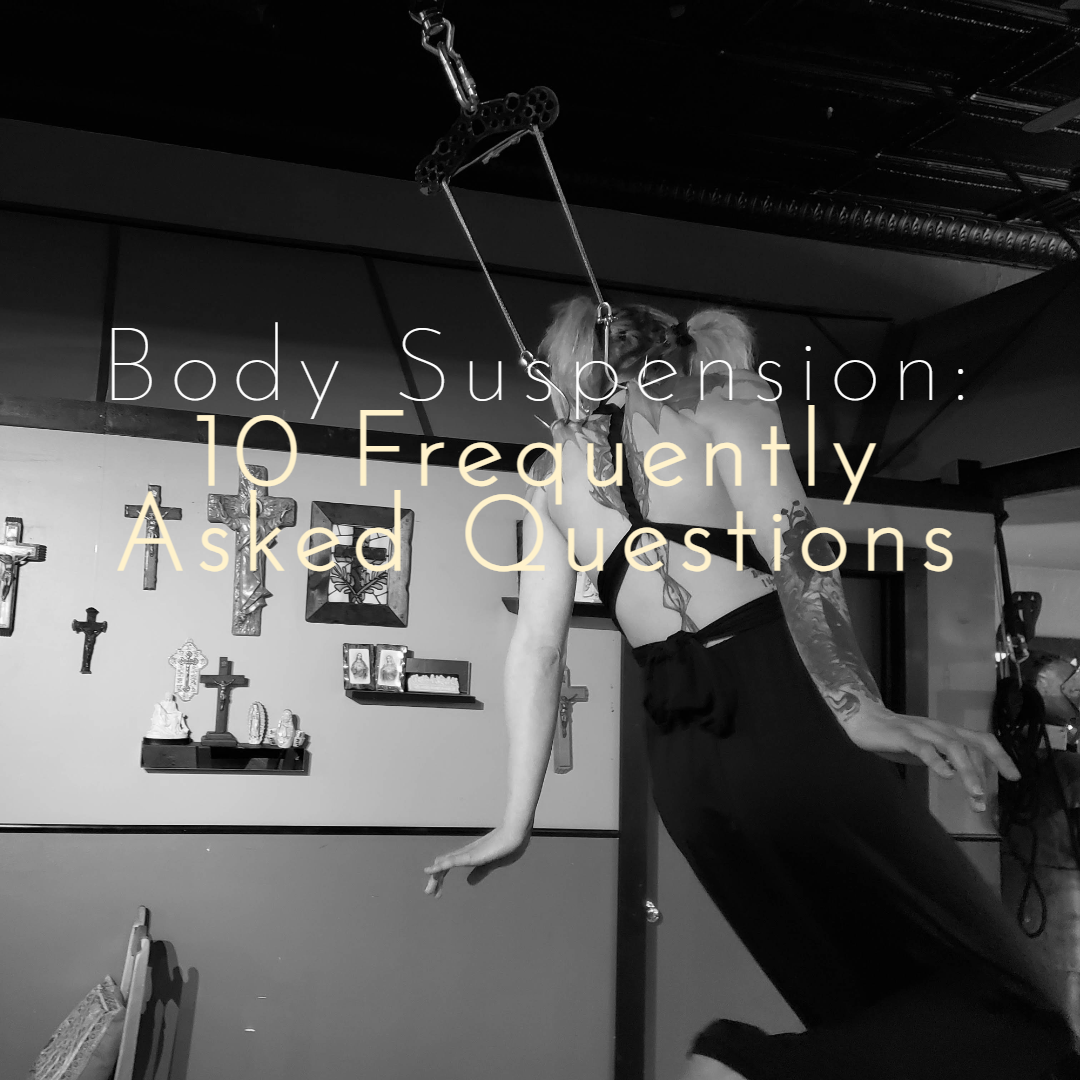
Body suspension is a practice that often leaves observers with many questions. Whether you are considering your first suspension or are simply curious about the mechanics of the ritual, these are the most common inquiries we encounter.
Below are ten frequently asked questions regarding the practice of body suspension. We have answered these from a high-level perspective but we are also including several personal insights to provide a broader view. Arrow, who has been suspending people as part of a professional team for 14 years, will share his viewpoint as a practitioner. Emilija will share her perspective as a veteran flyer who has suspended over 15 times, and Chris will contribute his experience as someone who has suspended fewer than five times.
1. Does it hurt?
Pain is subjective, but the short answer is yes: there is a distinct sensation involved. Most practitioners describe the initial piercing as a sharp pinch and the “pull” (the moment weight is applied) as an intense, burning pressure. However, once the body leaves the ground and the skin stretches, many experience an endorphin rush that replaces the sharp pain with a feeling of warmth, numbness, or even weightlessness.
ARROW: I would have to say yes. The level of pain kind of depends on the individual and type of suspension. Some spots are worse than others. Some people feel pain different than others. I can say it’s not like what you would think going into it.
EMILIJA: I myself would describe the initial hook placement as the part of the experience which can be painful, but even that is just a momentary bite of spiciness with each hook, which is then replaced with warmth and relaxation, for me. Pressure and pull in the actual process of liftoff, but once in the air, I often don’t take much notice of the hooks, and it is all about the flight itself from then on.
CHRIS: Yes, but I didn’t find it to be unbearable. I’ve felt more pain from a hard workout or running race. Actually going up, there was a burning and pinching sensation, but it gets a lot easier once you accept that it’s going to hurt some.
2. Why do people do it?
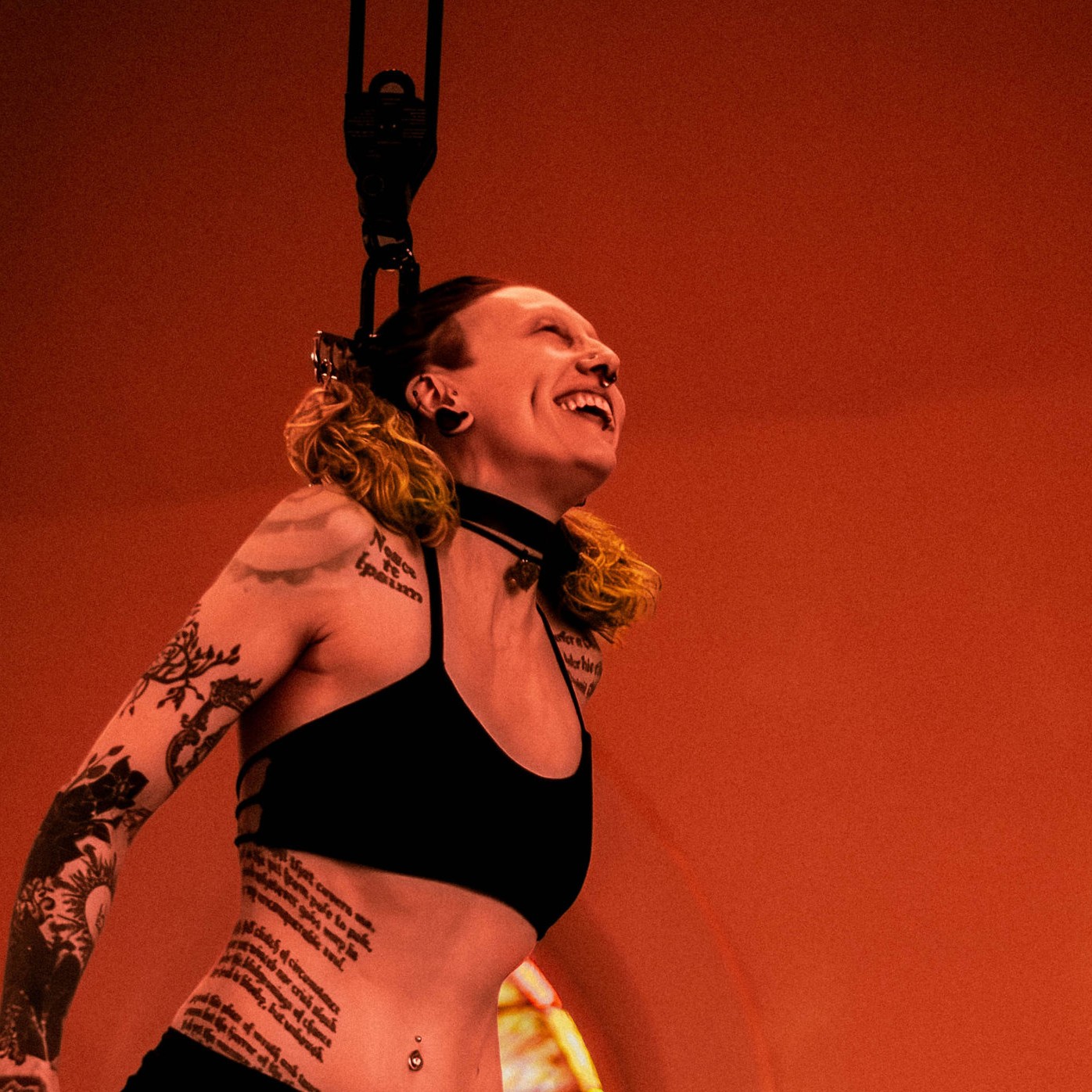
The reasons are as varied as the individuals. Some seek a meditative, out-of-body experience to gain spiritual clarity. Others do it to conquer a fear, to mark a major life transition, or to test the limits of their physical endurance. For many, it is a way to reclaim their body and experience a unique “high” caused by the body’s natural chemistry.
ARROW: I have seen all kinds of people suspend for different reasons. A sense of spiritual fulfillment or just because it seems fun. So many different things about it can attract people and not one way is the definitive right answer.
EMILIJA: So many things draw me to it, and every suspension holds a different chapter of the story, for me. I want to overcome fears while exploring the curiosity of what this could do for my mind and soul, to release inner torment, to challenge my body, to do something completely different in this one round I get on the planet. Once I was enlightened with all that suspension actually held for me, that it opened doors in my mind that otherwise do not exist…it easily became a part of my life and an experience I never cease to look forward to. Not sure how else to say it, but I have never felt more “home” within myself than I do when I am on hooks.
CHRIS: I wanted to suspend to say that I did it, and say that I could do it. But also, I wanted to see what there was to see. Sort of like hiking a mountain and, once on top, looking out far and wide. I wanted to suspend to help put things in perspective.
3. Am I too heavy?
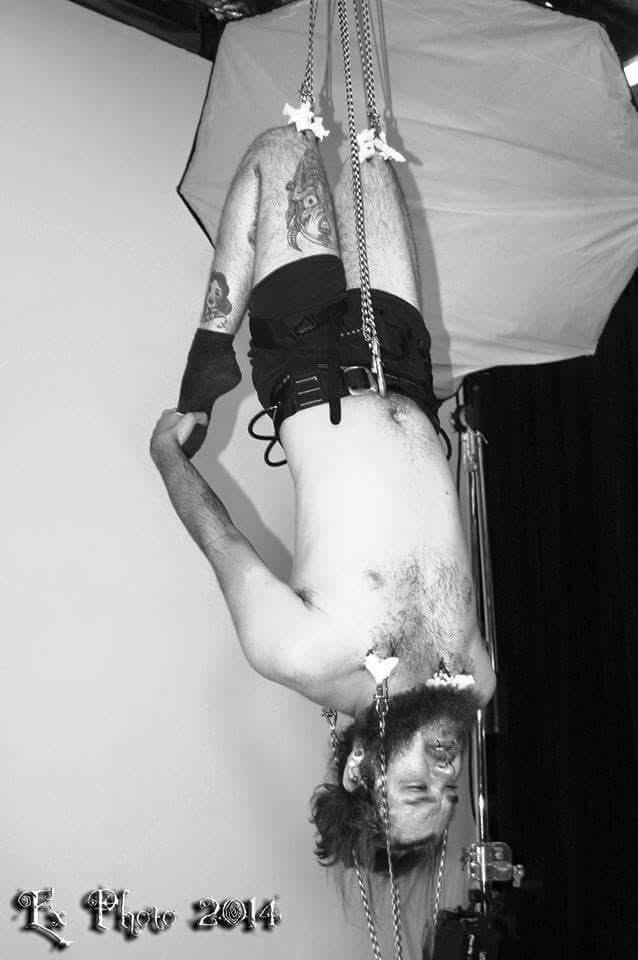
Human skin is incredibly resilient. While a common fear is that the hooks will “rip through,” skin is far stronger than most people realize. Suspension is not about weight; it’s about the number and placement of the hooks to distribute that weight evenly. Professional teams can safely suspend individuals of almost any body type by adjusting the rigging and hook count accordingly.
ARROW: No. I always recommend researching who is going to perform the suspension regardless of size. You want experience and knowledge for any suspension. Part of being a practitioner is knowing the best ways to safely suspend someone. This goes for all shapes and sizes. It’s all about distribution and knowing how to properly utilize your equipment.
EMILIJA: I am quite light at under 130lbs, but have witnessed individuals over 300lbs suspend without any tearing or complications whatsoever. It really is more about the proficiency of the practitioner and the number/placement of hooks and the rigging than it is anything to do with weight of the suspendee.
CHRIS: I’m light, under 150lbs, but I’ve watched people over 300lbs suspend effortlessly.
4. How do I find a reputable suspension team?
You should never attempt this alone or with untrained friends. Look for established groups with a public portfolio and a strong emphasis on safety and hygiene. Ask about their sterilization protocols (use of an autoclave is mandatory) and their experience with different “rigs” (placements). Reputable teams are usually happy to answer questions and will sometimes require an interview before agreeing to a suspension.
ARROW: I have to say doing your research is most important. Seeing if you can find portfolios and reviews on how the team works. Even going to an event and spectating if possible. Talking to people who have already suspended. Checking out groups and forums online can also help.
EMILIJA: I was fortunate enough to find my first team very nearby, through a friend of a friend who thought I might be into it, shortly after I moved here back in 2014. I spent nearly 2 years interacting with this little community and team, helping out at events and learning from them and experiencing the suspensions of others though, before I finally had my first, in 2016. In more recent times however, after 5 years of no outlet for this very important part of my world, and lacking individuals who know, I would say doing a deep dive on the internet is a good plan if you don’t happen to know anyone, and thereafter having discussions with team members once the queries have been made. I found the team that brought me back to my world of suspension in these recent times through a combination of Google and Instagram, which led me to their actual website which lent me more formal access to the team, to complete their consultation form and then to discuss things at greater length. Since connecting with that community, I have had the pleasure of discovering even more teams and communities that I have access to.
CHRIS: My first suspension was at a BME meetup with Sean Philips, I think. At the time, I knew he was respected and trusted. In hindsight, I put all my trust into what others thought of him (and the crew assisting him). If I had to do it again, I would have done some due diligence like reaching out to him beforehand, telling him it was my first time, and asking some basic questions. Thankfully Sean was fantastic, but I shouldn’t have gone on reputation alone.
5. How much does it cost?
The cost varies based on the team, the location, and the complexity of the suspension. Generally, you are paying for the single-use sterile needles and hooks, the rigging equipment, the rental of the space, and the expertise of the practitioners. Prices typically range from $200 to $500, though special events or private sessions may differ.
ARROW: It’s common for $200 as the baseline price sometimes more for more complex suspensions.
EMILIJA: Baseline is at least $150 to $200, and it ranges upward from there depending on the team and location and whether or not it is a private or a public event and other such factors.
6. Will it leave permanent scars?
Yes. Because the process involves piercing the skin with heavy-gauge hooks, there will be small, circular scars at the entry and exit points. With proper aftercare, these often fade into small “freckle-like” marks over time, but they are permanent modifications to your canvas.
ARROW: Yes. Much like any piercing some scaring will happen. They are most of the time very small and not noticeable unless looking for them. Some people who suspend regularly tend to get a bit more scarring. The body can also process differently from person to person causing more or less to show.
EMILIJA: Yes, but I do feel like this depends on the individual and how they heal. For example – the hook hole scars on my lower body have healed with more of a pink/purple hue, while those on my upper body which aren’t through tattoos are barely noticeable.
CHRIS: My scars are almost completely gone. If you look for them, and the air temp and blood flow are just right, you can still see them.
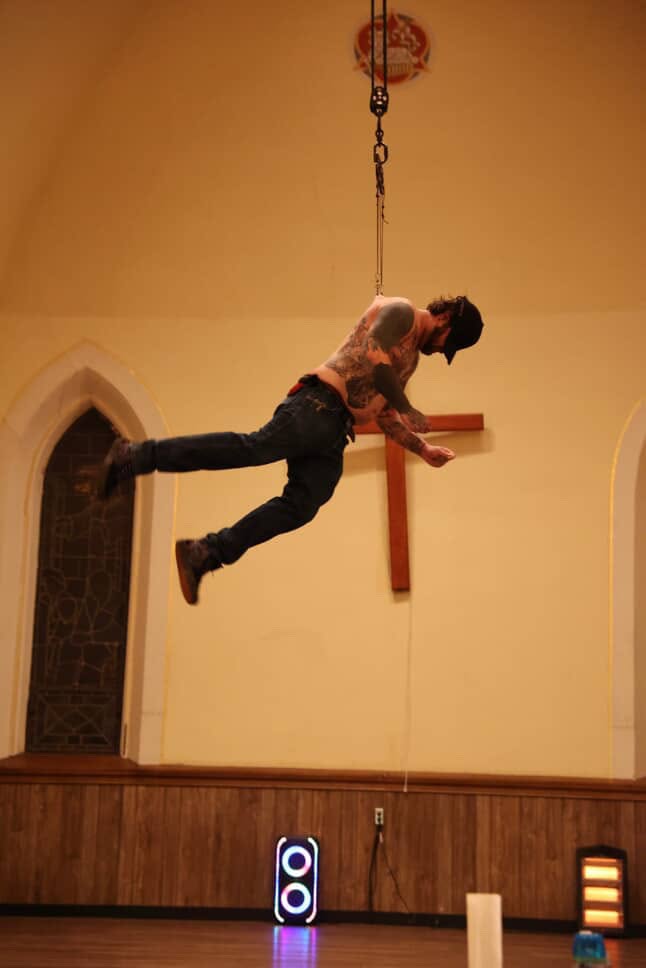
7. How long does a suspension last?
The duration is entirely up to the person hanging. Some stay up for only a few minutes to experience the sensation, while others may remain suspended for much longer, swinging or meditating. A professional team will always check in with you and lower you the moment you feel you have reached your limit.
ARROW: That’s the beauty of it you don’t have a “time limit”. This is something you and your practitioner work out. I have seen someone only go up a minute and come down. I have also seen someone go up for over an hour.
EMILIJA: I tend to stay up for quite awhile, if there are no hard limitations. My original team didn’t practice time constraints, so my first suspension lasted around an hour, beginning with pulling myself up and having some intensely positive quiet moments, and thereafter trying out a multitude of things with my team while in the air, including lots of big pushes and being spun and flung with all the giggles and glee at the newness of all these sensations that cannot be experienced any other way, really. Some teams do have time limits of around 15 or 20 minutes though, so as to keep to event schedules and ensure everyone gets the time they signed up for the day.
CHRIS: I never stayed up long. I had been to other meetups and watched people suspend before my first time going up, and there were people that would go up for two or three minutes, and then there were those that would be up for 20 minutes, swinging all around. I envisioned myself a “swinging all around” type person but it wasn’t for me.
8. What is “The Drop”?
“The Drop” refers to the physical and emotional “crash” that can happen after a suspension. When the endorphins and adrenaline wear off, you may feel shaky, exhausted, or emotionally overwhelmed. Professional teams provide a “cool down” area and encourage practitioners to eat sugary snacks and stay hydrated to manage this transition safely.
ARROW: The drop can be a bit different for everyone but after that release of endorphins you can get like an emotional low that you need to work through. This is how some people process traumas in life helping them feel what they need to feel. You can also not have a drop at all.
EMILIJA: I never feel a drop in the immediate afterward of a suspension. But for my first 4 or so, I did however experience what my first team referred to as “PSD” or “Post-Suspension Depression,” after anywhere between 3 days to a full week following a suspension. It was helpful to have community during those times, as the strange depths didn’t make much sense to me after having experienced as much joy as I did every time I went up. My mind and body did of course acclimate and I stopped having those intense lows in the days following a suspension. It was just a lot for me to process for the first while, experiencing the floods of endorphins and adrenaline and dopamine and all of the freedom within, and then all of those chemicals draining away as the experience also faded into the past. An adjustment period, but something worth mentioning to any individual that it is very normal if experienced; it does not last forever, and having support makes all the difference.
CHRIS: I never felt a drop afterwards.
9. Can I suspend if I have a low pain tolerance?
Surprisingly, yes. Many people with low pain tolerances find that the mental preparation and the gradual application of weight allow them to process the sensation differently than a sudden injury. The “mind over matter” aspect is a significant part of the ritual’s appeal.
ARROW: Yes, the body is amazing and it’s all what you can put your mind to. With my experience the team will also be your biggest supporters to help you push yourself to where you want to be but also understanding you have limits.
EMILIJA: I feel like outside of the initial hook placements themselves, I have found that it really is mostly mind over matter. Accepting what is happening. Reminding myself why I am doing this. And letting go. I refer to it as “settling into my skin” once I’m in the air; it’s like the deepest inhale and exhale ever, and in that breath, all the tension is released. It makes all the difference, as I’ve experienced the massive change in a tense body versus a relaxed one whilst on hooks. So, all that in mind, though I myself have a very high pain tolerance, I feel I can confidently say that even those with a low pain tolerance are still fully capable of having an incredible suspension.
CHRIS: I remember the piercing of the hooks being more painful than the actual suspending. Even so, each hook was done very quickly. Personally, I hate getting shots or blood drawn but it has more to do with the anticipation and dread leading up to it than the actual event. I found suspension to be sort of like that. Once I told myself, “This is happening, calm down, you’re going to be fine,” it became a perspective that was much easier to handle.
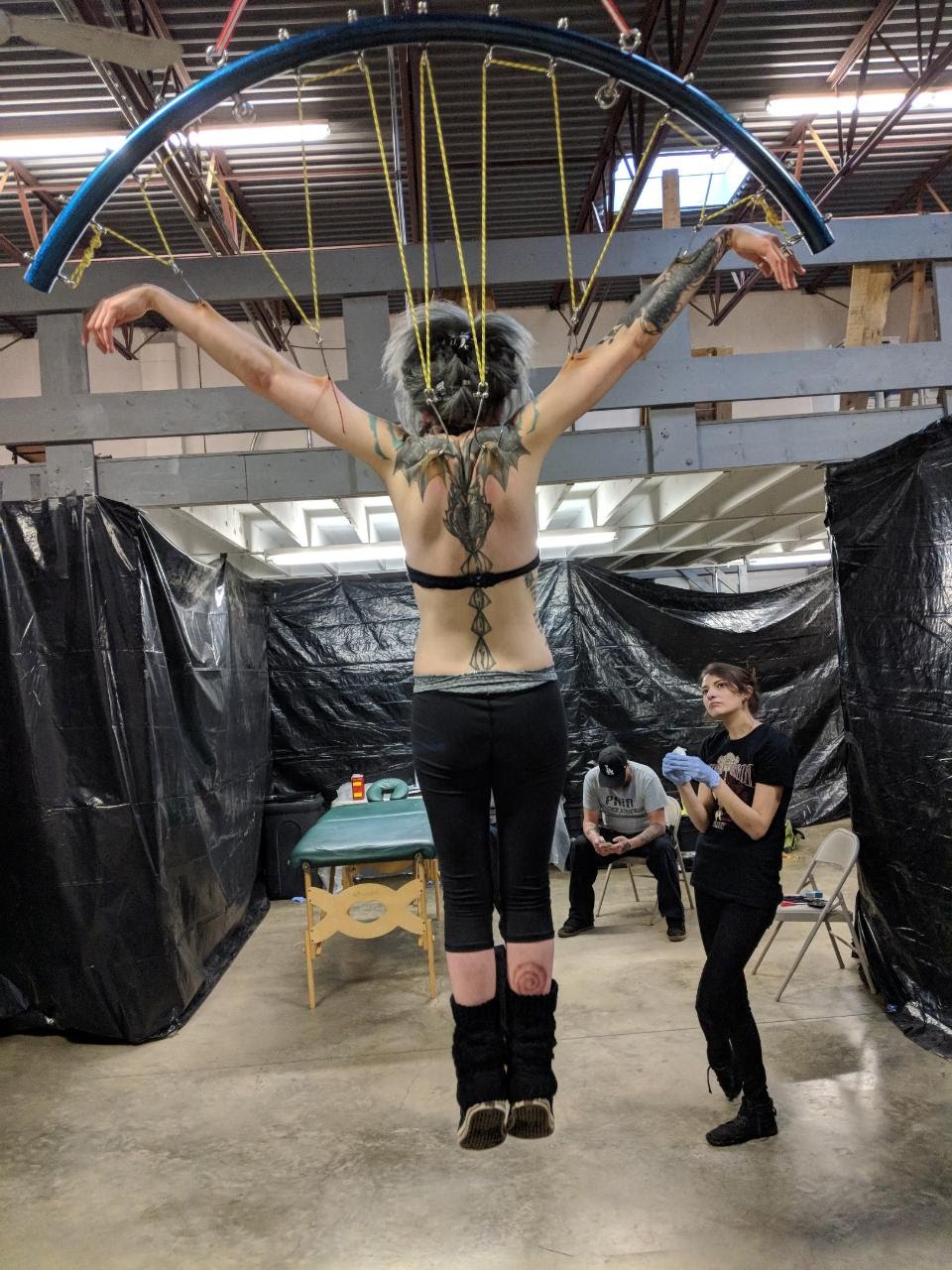
10. What is the most common suspension position?
A vertical suspension, where the hooks are placed in the upper back, is the most common for beginners. This position allows the practitioner to see what is happening and maintain a sense of orientation while they are in the air.
ARROW: I would say a vertical two point back suspension. Next would be a chair position with hooks being in the back and knees.
EMILIJA: The most common suspension position I see, and what I also began with, is what was introduced to me as the “suicide” position, which is two points in the upper back. Suspended upright. I would call this the most “free” way to suspend, as I have more options to experiment with movement with all of the limbs being unrestricted. I went with a bit of a challenge for my second though, and did a six-point suspension with the “lotus” position.
CHRIS: My first was a vertical suspension and I think my second was a forearm suspension.