The ritual is over. The skin has healed. The jewelry has settled. The sacred work you did in a quiet room, surrounded by friends or perhaps alone with your own thoughts, is now complete.
But then, you have to go to the grocery store. You have to go to a parent-teacher conference. You have to sit in a meeting at work. And this is where the next phase of our spiritual practice begins: carrying our sacred selves through the mundane world.
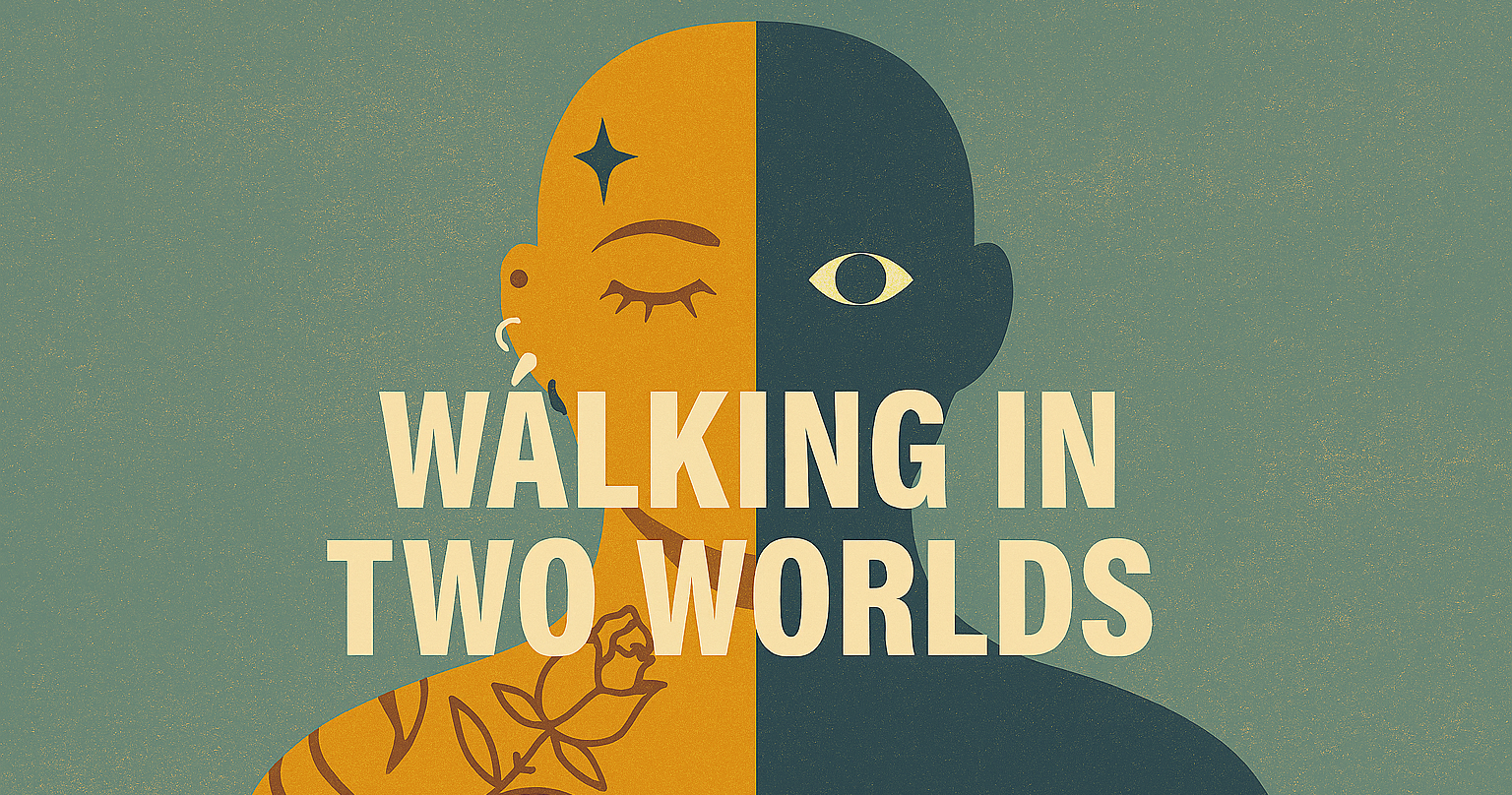
We walk in two worlds simultaneously. There is the inner world, where our modifications are rich with meaning – they are memorials, vows, declarations of survival, and anchors to our spirit. And then there is the outer world, which often sees only the surface. It sees a tattoo, a piercing, a scar, and reduces a profound spiritual act to a simple aesthetic choice, or worse, a reason for judgment.
Navigating this gap between the marked and the mundane is a crucial part of our path.
The Weight of the World’s Gaze
Let’s be honest: it isn’t always easy. The stares from strangers, the intrusive questions from coworkers, the concerned looks from family who don’t understand. “What will you do when you’re old?” “Did that hurt?” “What did you do that for?”
Each question, no matter how well-intentioned, can feel like a small attack against the sacredness of our experience. It can be exhausting to feel like a walking exhibit, to have the story of your soul treated like a curious novelty. The mundane world constantly asks us to explain, to justify, to make our spiritual journey palatable for public consumption.
It is easy to become defensive, to withdraw, to hide the parts of ourselves that the world doesn’t readily accept. But that is not our way. Our practice is not one of hiding. It is one of presence.
The Mark as an Anchor and a Shield
The true test of our faith is not what happens in the chair or under the hook; it’s what happens in the checkout line. This is where our marks reveal their true power.
In a moment of stress at work, the feeling of a piercing can be a secret anchor, a physical reminder of your strength and your core beliefs. Catching a glimpse of a meaningful tattoo in the mirror can be a source of quiet power, reconnecting you to the vow you made to yourself. Our modifications become our spiritual armor in the mundane world. They are a constant, silent conversation we have with ourselves.
They also act as a filter. Those who are frightened or repelled by our appearance often filter themselves out of our lives, leaving room for those who are curious, open-minded, and willing to see beyond the surface. Our bodies, in their honesty, attract our true tribe.
The Sacred Art of Translation
Living in these two worlds requires us to become translators. We must learn how to translate our profound inner experiences into a language the mundane world can, on some small level, understand.
You don’t owe anyone your whole story. You don’t have to lay bare the sacred details of your ritual for a curious stranger. But we can choose to answer with simple, honest truths. When asked what a piece means, perhaps the answer is, “It’s a reminder to be brave.” Or, “It marks an important time in my life.”
Each of these small acts of translation is a spiritual practice. It is an opportunity to bridge the gap, to plant a seed of understanding, and to represent our community with grace. It reinforces our own beliefs by forcing us to connect with their essential truth.
Living as a marked person in an unmarked world is not a burden. It is a calling. It asks us to be ambassadors for our own souls, to carry our sacred truths with integrity, and to remember that even in the most mundane of moments, we are living altars. We are walking, breathing proof that the sacred and the everyday can exist in the very same skin.